Throw it
harder.
Film one pitch on your phone. Velo Lab tracks every frame, measures what your body did, and tells you the one change worth the most mph.
Invite-only for now: signing up needs an invite code.
- Clip
- –
- Camera
- iPhone, side-on
- Pitches
- –
- Throws
- –
What goes in,
what comes out
You give it a side-on clip and your height. It hands back what your body actually did, how that compares with 100 pitchers measured in a biomechanics lab, and the one thing to change.
In

- the clip
- 61 s, 4 pitches, side-on, 30 fps
- your height
- 180 cm, for scale
- a radar reading
- optional (none this time)
Out
And the one thing to change
–
Release happens
between frames
The hand is the fastest thing on the field. Normal video catches a frame every 33 ms, and by then the ball is long gone. Slow-mo sees every millimetre of it.

Frames from an iPhone 240 fps clip filmed in a pitching lab.
So is your stride any good?
On its own a number tells you nothing. Yours goes next to 100 pitchers measured in a biomechanics lab.
Shaded: the middle half of the 100 pitchers. Ticks: 10th, 50th and 90th percentile.
What actually
moves velo
Going from an average to a good value on each measurement, and what that's worth in the lab data, adjusted for body size.
of the differences in velo between those pitchers come from the mechanics a side-on camera can see. The rest is strength, power and arm speed. Velo Lab says so instead of promising mechanics will fix it, and that's why mobility and strength come next.
It won't guess
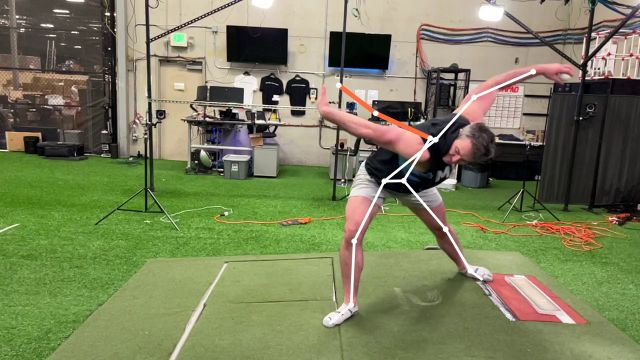
This throw was filmed from the front on a handheld phone. Stride and trunk angles are foreshortened from there, so Velo Lab tracks it but refuses to coach off it, and tells you how to re-film. Wrong numbers are worse than none.
What you get
The measuring is the engine. This is what it drives.

-
One thing to change.
Not a wall of numbers: the single change with the biggest clear mph payoff, with the reason.
-
Tests against the lab.
Jump, rotation, strength and grip, each next to Driveline athletes at your level.
-
A 12-week plan.
Built from your gaps, your kit and your injury history, with the reason for each exercise.
-
A coach that reads the frames.
A filmstrip of your delivery and your numbers come back as a cue, the why, and a drill.